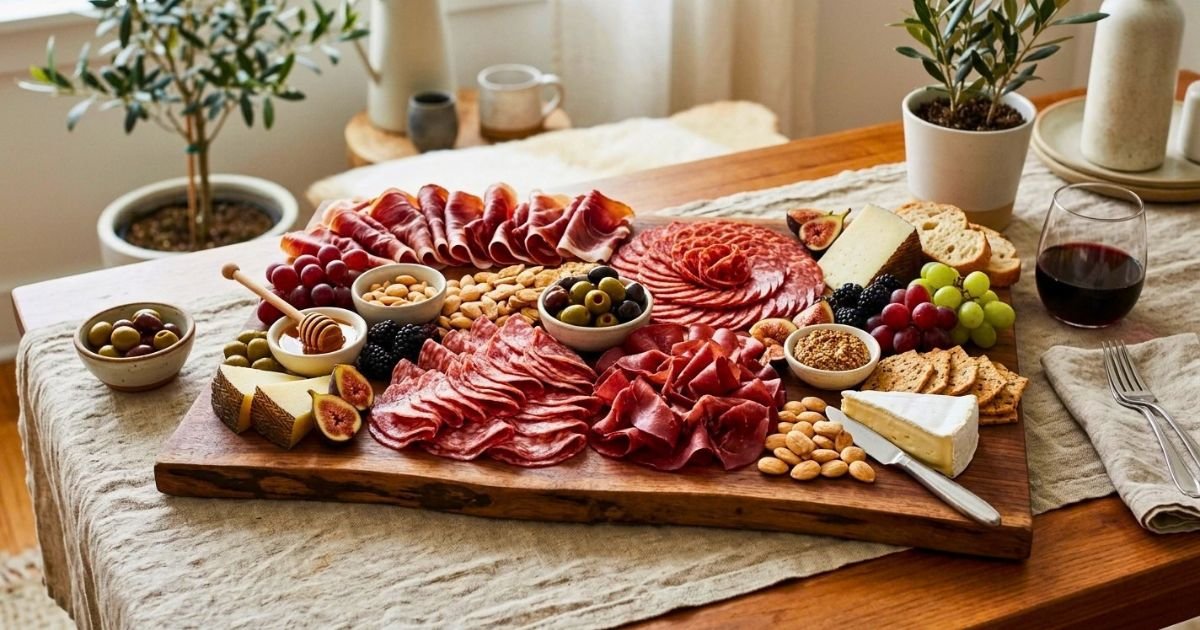
Why Your Knife Struggles with Hard Cheese and How to Fix It?
Few kitchen frustrations compare to trying to cut a beautiful wedge of aged cheese only to watch it crumble into uneven chunks. You start with good intentions, placing a sharp knife against a block of Parmesan or aged Gouda, expecting clean slices. Instead, the blade sticks halfway through, the cheese cracks unexpectedly, and your serving board ends up covered with broken pieces rather than elegant portions.
The problem is more common than most people realise. Whether you’re preparing a charcuterie board, assembling a sandwich, grating ingredients for a recipe, or serving guests at a dinner party, cutting hard cheese can become surprisingly difficult without the right technique and tools.
Many people assume the issue is simply a dull knife, but the reality is more complex. Cheese texture, moisture content, ageing processes, blade design, cutting angle, and even room temperature all influence how successfully a cheese can be sliced.
The good news is that hard cheese does not have to be difficult to manage. Once you understand why your knife struggles and learn the proper cutting methods, you can achieve clean slices, perfect chunks, and attractive presentations every time.
This comprehensive guide explains:
- Why do hard cheeses resist ordinary knives
- Common mistakes that cause cracking and crumbling
- The best tools for different cheese varieties
- Professional cutting techniques used by cheesemongers
- Maintenance tips for cheese knives
- Solutions to common cutting problems
- Essential safety practices

By the end of this guide, you’ll know exactly how to handle everything from Parmesan and Pecorino to aged Cheddar, Gruyère, Manchego, and other firm cheeses with confidence.
Table of Contents
Why Hard Cheese Is So Difficult to Cut?
Many people assume all cheese behaves similarly, but hard cheese is fundamentally different from soft and semi-soft varieties. As cheese ages, moisture gradually evaporates while proteins, fats, and flavour compounds become increasingly concentrated. This ageing process creates the firm texture and rich taste that make hard cheeses so desirable.
Unfortunately, those same qualities also make them difficult to slice.
Moisture Loss Creates Density
Fresh cheeses contain significant amounts of water.
As ageing progresses:
| Cheese Type | Approximate Moisture Content |
| Brie | 48–52% |
| Mozzarella | 50–60% |
| Young Cheddar | 38–42% |
| Aged Gouda | 28–34% |
| Parmesan | 25–30% |
Lower moisture means greater density. A dense cheese resists the blade instead of yielding easily, forcing the cheese knife to work much harder.
Protein Crystals Increase Resistance
Many aged cheeses develop protein crystals known as tyrosine crystals.
These tiny crunchy formations are prized for flavour and texture, but they also create natural fracture points.
When pressure is applied incorrectly:
- The cheese breaks unexpectedly
- Cracks form along crystal lines
- Pieces separate unevenly
- Slices become jagged
This explains why Parmesan often breaks apart rather than slicing cleanly.
Hard Rinds Add Another Challenge
Many aged cheeses develop extremely tough rinds.
Examples include:
- Parmesan
- Pecorino Romano
- Manchego
- Aged Gouda
The rind protects the cheese during maturation but creates additional resistance during cutting.
Your knife must penetrate:
- The hard outer rind
- The dense interior
- The crystalline structure
This combination creates significant cutting resistance.
Friction Causes Sticking
Even when a knife successfully enters the cheese, friction becomes another obstacle.
As the blade travels through the cheese:
- Pressure increases
- Surface contact expands
- Cheese begins gripping the metal
- The blade slows down
The wider the blade, the greater the friction. This explains why many standard chef’s knives become stuck halfway through large blocks of cheese.
Ageing Changes Texture
Not all hard cheeses behave identically.
Younger Hard Cheeses
Examples:
- Mild Cheddar
- Young Gouda
- Young Manchego
Characteristics:
- Slightly flexible
- Easier to slice
- Less prone to cracking
Extra-Aged Hard Cheeses
Examples:
- Parmigiano-Reggiano
- Pecorino Romano
- 36-month Gouda
Characteristics:
- Extremely dense
- More brittle
- Higher crystal content
- More likely to fracture
The older the cheese, the more important proper cutting techniques become.
Common Knife Problems
Many cutting frustrations stem from using the wrong knife or technique.
Let’s examine the most common issues.
Hard Cheese and the Wrong Knife
Most household knives are designed for:
- Vegetables
- Fruits
- Boneless meats
- Bread
Hard cheese presents entirely different challenges.
When a thin kitchen knife encounters dense cheese:
- The blade flexes
- Cutting pressure increases
- Friction builds
- Control decreases
As a result, the knife struggles to move smoothly through the cheese.
Common Knife Issues
| Knife Type | Problem With Hard Cheese |
| Chef’s Knife | Wide blade creates sticking |
| Paring Knife | A wide blade creates sticking |
| Butter Knife | Insufficient sharpness |
| Utility Knife | Limited stability |
| Bread Knife | Creates uneven cuts |
Poor handling and dull blades
Even premium knives perform poorly when dull. A sharp blade cuts efficiently because it concentrates force into a tiny cutting edge.
A dull blade:
- Crushes instead of cuts
- Requires extra pressure
- Causes slipping
- Produces uneven slices
Signs your knife needs sharpening:
- Cheese crumbles excessively
- Blade skids across rind
- Extra force is required
- Cuts appear rough
Proper maintenance dramatically improves cutting performance.
Safety Risks and Wasted Cheese
Many people underestimate the safety concerns associated with hard cheese.
When excessive force is used:
- Knives can slip suddenly
- Hands move toward the blade
- Stability decreases
- Injury risk rises
Hard cheese often requires more pressure than vegetables or soft foods.
Without proper tools:
- Valuable cheese is wasted
- Portions become inconsistent
- Presentation suffers
- Accidents become more likely
For premium cheeses, poor cutting can become expensive. A $30 wedge of aged Parmesan deserves better treatment than random chunks and crumbles.
Essential Tools for Cutting Hard Cheese
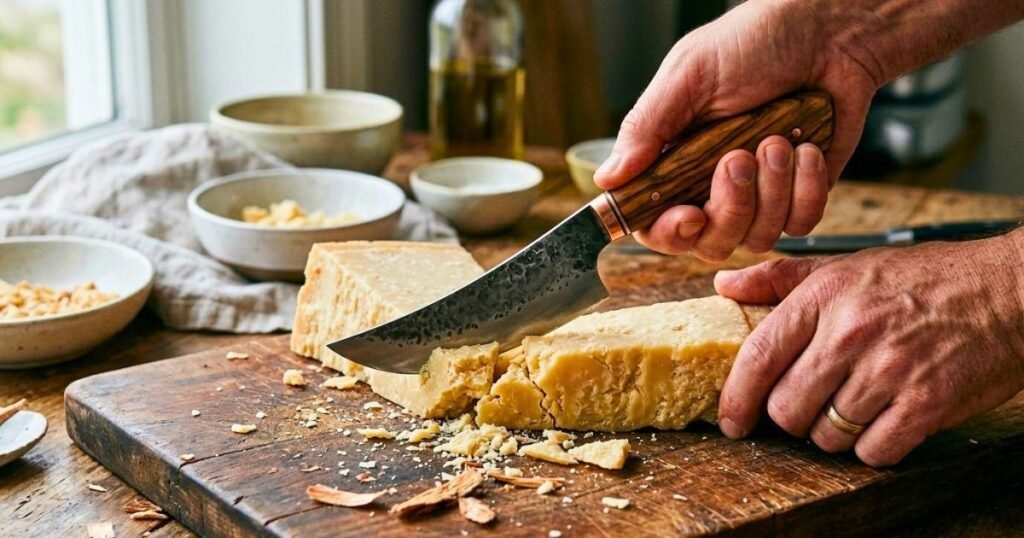
Using specialised cheese tools immediately improves results. Professional cheesemongers rarely rely on ordinary kitchen knives for hard cheese. Instead, they use tools designed specifically for dense textures.
Hard Cheese Knives
Hard cheese knives prioritise strength, leverage, and control.
Double-Handle Cheese Knife
This large knife features handles on both ends.
Benefits:
- Even pressure distribution
- Greater control
- Easier cutting through large wheels
- Reduced wrist strain
Best for:
- Parmesan wheels
- Large Gouda wheels
- Commercial applications
Dutch Cheese Knife
Recognizable by its T-shaped handle.
Advantages:
- Excellent leverage
- Comfortable grip
- Efficient downward force
- Ideal for firm cheeses
Best for:
- Gouda
- Edam
- Gruyère
Parmesan Knife (Almond Knife)
Small and pointed. Unlike traditional knives, it’s designed to break cheese naturally.
Benefits:
- Preserves texture
- Creates attractive chunks
- Works with crystalline structures
Best for:
- Parmesan
- Pecorino
- Aged Asiago
Wide Spade Knife
A sturdy triangular blade designed for pressure.
Advantages:
- Strong leverage
- Durable construction
- Easy handling
Excellent for:
- Hard cheddar
- Manchego
- Swiss-style cheeses
Fork-Tipped Cheese Knife
Combines cutting and serving functions.
Benefits:
- Easy serving
- Reduced handling
- Attractive presentation
Useful for:
- Charcuterie boards
- Entertaining guests
- Cheese platters
Cheese Cleavers and Wires
Some cheeses require tools beyond traditional knives.
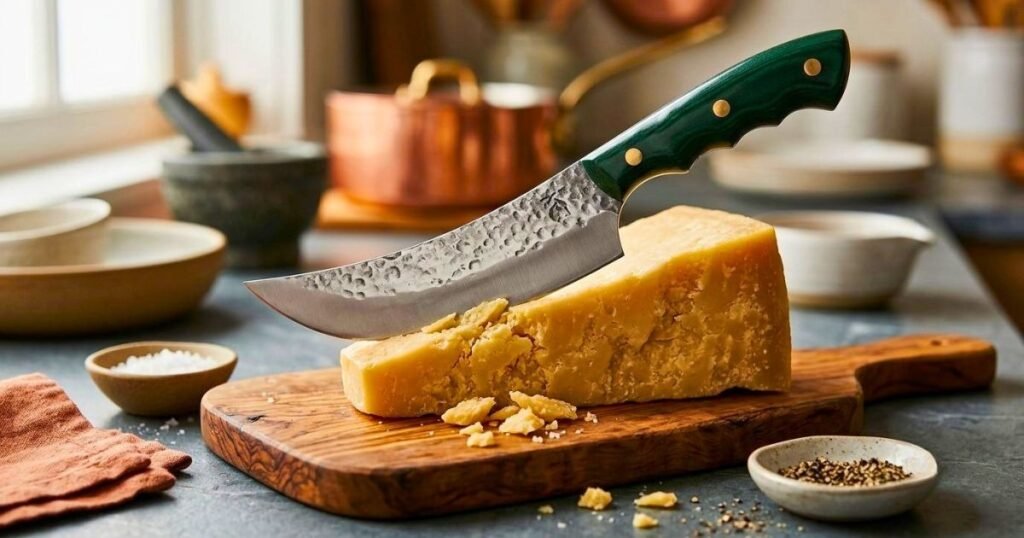
Cheese Cleaver
A miniature version of a meat cleaver.
Advantages:
- Handles tough rinds
- Excellent force transfer
- Very durable
Best for:
- Aged Cheddar
- Gruyère
- Dense Alpine cheeses
Cheese Wire Cutter
A wire cutter minimises friction.
Benefits:
- Extremely clean cuts
- Less sticking
- Uniform slices
- Minimal waste
Best for:
- Presentation slices
- Semi-hard cheeses
- Firm cheeses
| Tool | Best For | Advantages |
| Parmesan Knife | Aged Parmesan | Natural breaking |
| Dutch Cheese Knife | Gouda | Strong leverage |
| Cheese Cleaver | Dense blocks | Powerful cutting |
| Wire Cutter | Thin slices | Minimal sticking |
| Fork-Tipped Knife | Serving | Dual-purpose use |
Special Cutting Boards and Support Techniques
Even the best knife performs poorly on an unstable surface.
A quality cutting board should provide:
- Stability
- Durability
- Adequate space
- Slip resistance
Recommended Board Materials
| Material | Benefits |
| Hardwood | Durable and knife-friendly |
| Bamboo | Eco-friendly and stable |
| Composite | Low maintenance |
| Plastic | Easy sanitation |
Extra Stability Tip
Place:
- A damp kitchen towel
- Silicone mat
- Non-slip liner
Underneath the board. This prevents movement during cutting and greatly improves safety.
Step-by-Step Cutting Techniques

Owning the right cheese knife is important, but technique is what ultimately determines whether you achieve clean, professional-looking slices or end up with broken pieces and wasted cheese. Professional cheesemongers understand that every cheese has unique characteristics, and they adjust their cutting method accordingly.
The following techniques will help you cut hard cheeses more efficiently while preserving their texture, flavour, and appearance.
Preparing the Cheese
One of the most overlooked steps in cheese cutting happens before the knife ever touches the cheese.
Many people remove cheese directly from the refrigerator and immediately begin cutting. This often leads to cracking, crumbling, and uneven slices.
Why Temperature Matters
Cold cheese is significantly firmer and more brittle than cheese served at room temperature.
When hard cheese is extremely cold:
- Fats remain solid
- Texture becomes rigid
- Crystals become more pronounced
- Cracking increases
Allowing cheese to warm slightly softens the structure and makes cutting easier.
Recommended Resting Times
| Cheese Type | Resting Time |
| Parmesan | 30–45 minutes |
| Aged Cheddar | 20–30 minutes |
| Gouda | 20–30 minutes |
| Gruyère | 20–30 minutes |
| Pecorino Romano | 30 minutes |
Bringing cheese closer to serving temperature not only improves cutting but also enhances flavour and aroma.
Correct Knife Grip and Leverage
Proper grip improves both safety and cutting efficiency.
One-Handed Grip
For smaller knives:
- Hold the handle firmly.
- Keep fingers wrapped securely.
- Maintain wrist alignment.
- Use smooth downward pressure.
Avoid squeezing excessively, which causes fatigue and reduces control.
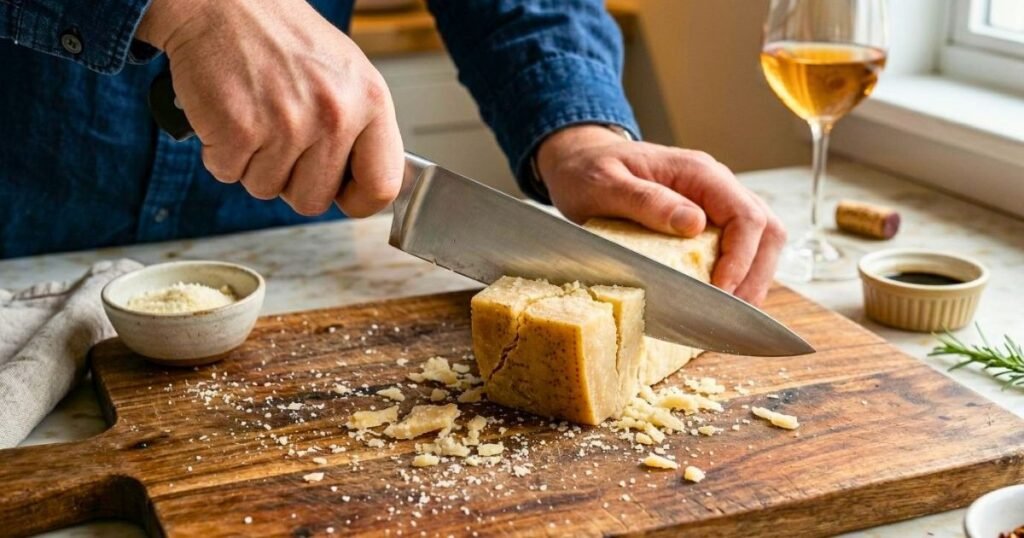
Two-Handed Pressure Technique
For larger hard-cheese knives:
- Grip the handle firmly.
- Place your non-dominant hand on the top of the blade spine.
- Apply even downward pressure.
- Let the blade do the work.
This technique provides:
- Better control
- Improved stability
- Reduced slipping
- Cleaner cuts
Cutting Large Wedges
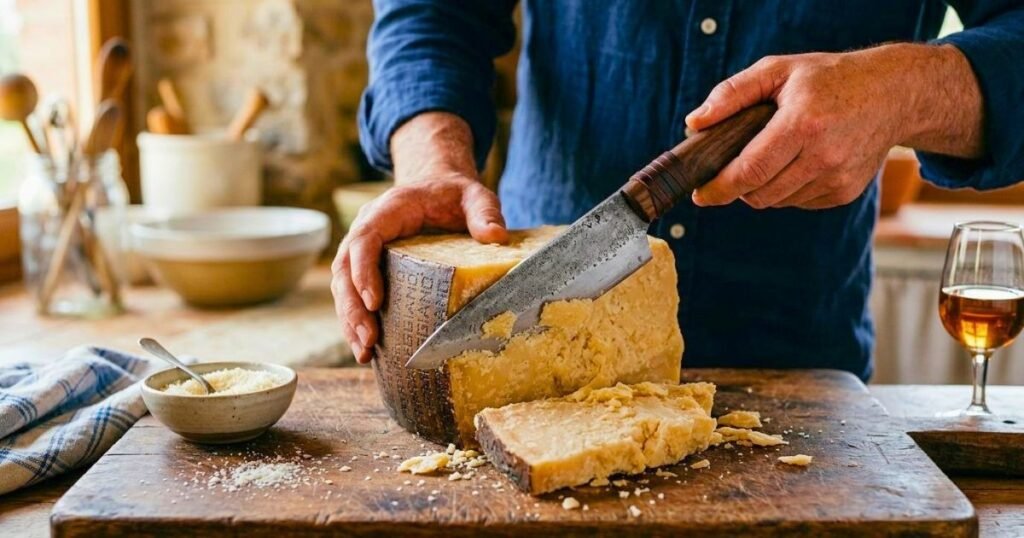
Large wedges require a different approach than small blocks.
Step-by-Step
- Place cheese on a stable cutting board.
- Position the knife at the top centre.
- Apply steady downward pressure.
- Cut in a straight line.
- Avoid twisting the blade.
Twisting often causes:
- Uneven slices
- Crumbling
- Blade sticking
Slow, consistent pressure produces better results than forcing the knife through quickly.
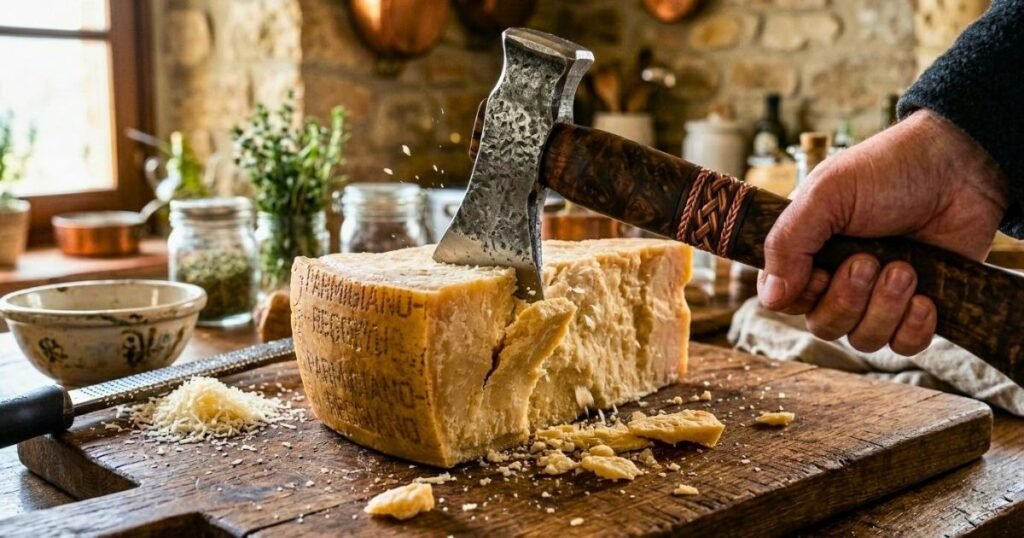
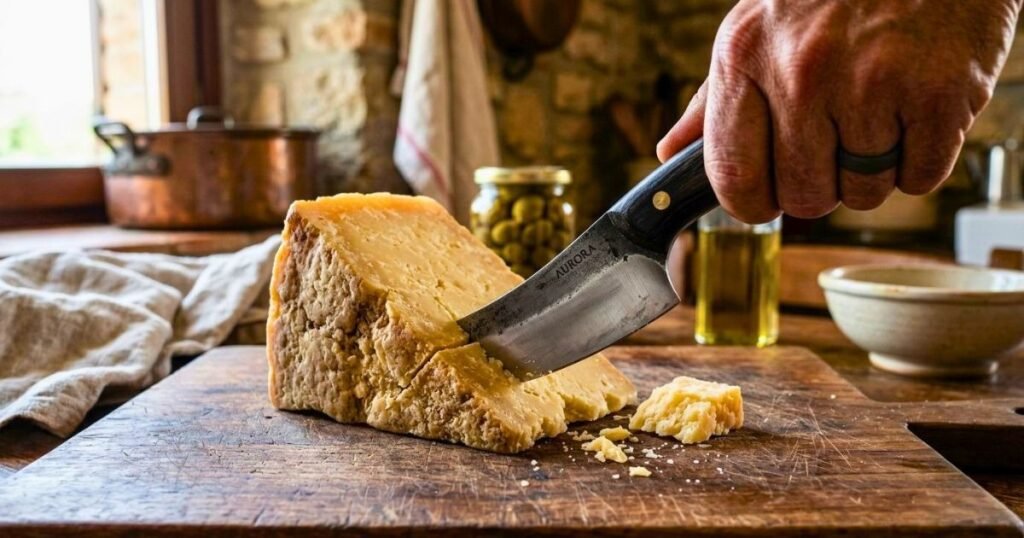
Breaking Parmesan the Traditional Way
Parmigiano-Reggiano is traditionally not sliced. Instead, professionals use a Parmesan knife to break it naturally.
Traditional Method
- Score the rind around the desired section.
- Insert the tip of a Parmesan knife.
- Twist gently.
- Allow the cheese to separate naturally.
Benefits include:
- Preserving texture
- Highlighting crystals
- Creating attractive chunks
- Maintaining an authentic presentation
This method is commonly used in Italian cheese shops and restaurants.
Slicing Semi-Hard Cheeses
Semi-hard cheeses benefit from smooth slicing motions.
Examples include:
- Young Gouda
- Swiss cheese
- Havarti
- Young Cheddar
Best Technique
Instead of pressing straight down:
- Start at the heel of the blade.
- Pull the knife forward.
- Complete the cut in one motion.
This reduces friction and produces smoother slices.
Using a Wire Cutter, Cheese Slicer, or Mandoline
Specialised tools provide exceptional consistency.
Cheese Wire
A wire cutter creates:
- Uniform slices
- Minimal sticking
- Less crumbling
Professional cheese counters frequently use wire systems because they create virtually no compression.
Scandinavian Cheese Slicer
This tool excels with:
- Semi-hard cheeses
- Swiss cheese
- Gouda
Advantages include:
- Consistent thickness
- Easy operation
- Attractive presentation
Mandoline Slicer
A mandoline can produce paper-thin cheese slices.
However:
- Always use a hand guard.
- Keep fingers away from the blade.
- Work slowly.
Safety should always take priority over speed.
Professional Cheese Cutting Tips
Experienced cheesemongers often follow these practices:
Cut From the Centre
For wedges, cut from the centre outward.
Benefits:
- More balanced portions
- Better presentation
- Even distribution of texture
Clean the Blade Frequently
Cheese residue creates friction.
Wipe the blade every few cuts using:
- A clean cloth
- Warm water
- A paper towel
This simple step dramatically improves performance.
Match the Tool to the Cheese
| Cheese Type | Recommended Tool |
| Parmesan | Parmesan Knife |
| Pecorino | Almond Knife |
| Gouda | Dutch Cheese Knife |
| Gruyère | Cheese Cleaver |
| Swiss Cheese | Cheese Slicer |
| Aged Cheddar | Hard Cheese Knife |
Choosing the proper tool often matters more than brute force.
Maintenance for Cheese Knives
A quality cheese knife can last for decades when properly maintained.
Regular care preserves:
- Sharpness
- Safety
- Appearance
- Performance
Sharpening and Caring for Hard Cheese Knives
Hard cheese places tremendous stress on cutting edges. Even premium knives eventually become dull.
Signs Your Knife Needs Sharpening
- Increased resistance
- Jagged cuts
- Cheese crumbling excessively
- Blade slipping
If cutting feels difficult, sharpening is usually necessary.
Sharpening Frequency
| Usage Level | Sharpening Frequency |
| Occasional Home Use | Every 6–12 Months |
| Frequent Home Use | Every 3–6 Months |
| Professional Use | Monthly or As Needed |
Regular honing between sharpenings also helps maintain performance.
Protecting Stainless Steel Blades
Most cheese knives use stainless steel because it offers:
- Rust resistance
- Durability
- Easy maintenance
To protect the blade:
- Wash promptly after use.
- Dry immediately.
- Avoid prolonged soaking.
- Store properly.
Even stainless steel benefits from good care.
Cleaning and Storing for Long-Term Performance
Proper cleaning prevents buildup and corrosion.
Recommended Cleaning Method
- Wash by hand.
- Use warm water.
- Apply mild dish soap.
- Rinse thoroughly.
- Dry immediately.
Avoid harsh chemicals that can damage handles or finishes.
Storage Options
Knife Block
Advantages:
- Blade protection
- Easy organization
- Reduced accidents
Magnetic Strip
Benefits:
- Quick access
- Space saving
- Good visibility
Blade Guards
Ideal for:
- Drawer storage
- Travel
- Protection against edge damage
Troubleshooting Cutting Problems
Even with excellent tools, problems occasionally occur. Understanding the cause makes solving them easier.
Signs It’s Time to Upgrade Your Knife
Not every knife is suitable for hard cheese.
Consider replacing your knife if:
- Blade flexes excessively
- The handle feels loose
- Cuts require significant force
- Edge dulls quickly
Quality tools provide:
- Better safety
- Cleaner cuts
- Longer lifespan
What to Do if Cheese Still Cracks or Knives Stick
Problem: Cheese Cracks
Possible Causes:
- Cheese too cold
- Excessive pressure
- Incorrect knife type
Solutions:
- Warm the cheese slightly
- Use gradual pressure
- Switch to a specialised cheese knife
Problem: Knife Sticks
Possible Causes:
- Wide blade
- Residue buildup
- High friction
Solutions:
- Clean the blade frequently
- Use a wire cutter
- Lightly oil the blade surface
Solutions if Knives or Wires Don’t Work
Some cheeses are exceptionally challenging.
Examples:
- Extra-aged Parmesan
- Aged Pecorino
- Crystalline Gouda
Alternative Approach
- Score the rind.
- Insert a Parmesan knife.
- Twist gently.
- Separate naturally.
This works with the cheese rather than against it.
Common Problem-Solution Table
| Problem | Cause | Solution |
| Cheese Crumbles | Too Cold | Bring to Room Temperature |
| Knife Sticks | High Friction | Wipe Blade Frequently |
| Uneven Slices | Wrong Tool | Use Proper Cheese Knife |
| Excessive Force Needed | Dull Blade | Sharpen Knife |
| Cheese Splits | Incorrect Pressure | Cut More Slowly |
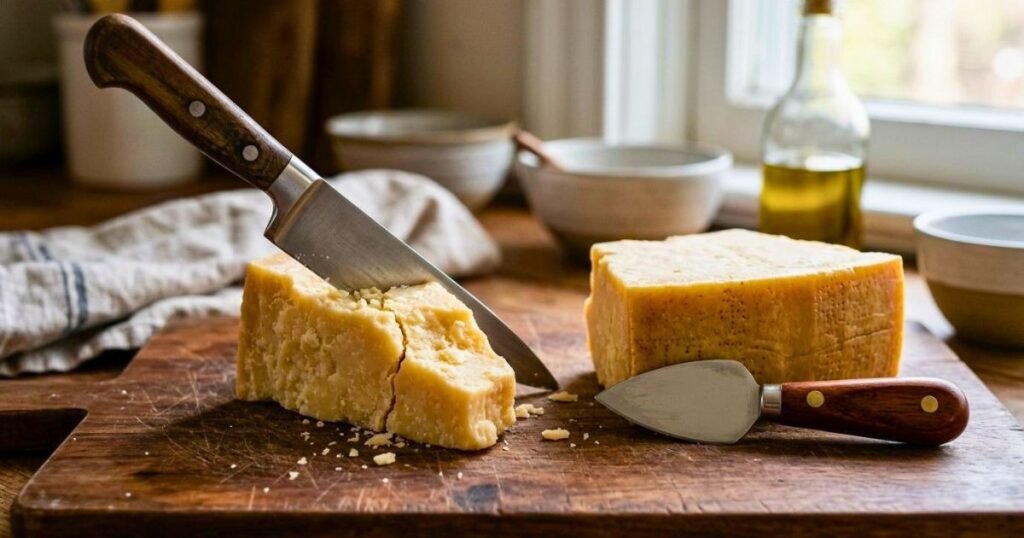
Safety Tips
Hard cheese requires more force than many other foods, making safety particularly important.
Preventing Slips and Injuries
Always prioritise stability.
Safety Checklist
✔ Stable cutting board
✔ Dry hands
✔ Adequate workspace
✔ Proper lighting
A stable setup dramatically reduces accidents.
Importance of Control and Steady Pressure
Many injuries occur because users rush.
Instead:
- Work slowly.
- Maintain control.
- Apply consistent pressure.
- Focus on the task.
Remember: controlled pressure is safer than brute force.
Additional Safety Practices
Keep Fingers Curled
Professional chefs use the “claw grip.”
Benefits:
- Protects fingertips
- Improves control
- Enhances accuracy
Never Force the Blade
If a knife stops moving:
- Pause
- Reposition
- Evaluate the situation
Forcing a stuck blade increases injury risk.
Use Appropriate Tools
The safest tool is usually the one designed specifically for the task.
Using:
- Parmesan knives
- Cheese cleavers
- Wire cutters
Reduces risk significantly compared to forcing a standard kitchen knife.

Frequently Asked Questions: Knife Struggles with Hard Cheese
Q. Why is hard cheese harder to cut than soft cheese?
- Hard cheese contains less moisture and more concentrated proteins, making it denser and more resistant to cutting.
Q. What is the best knife for Parmesan?
- A Parmesan or almond knife is best because it breaks the cheese naturally along its crystalline structure.
Q. Should cheese be cold when cutting?
- No. Most hard cheeses cut better after sitting at room temperature for 20–45 minutes.
Q. Why does my knife stick in cheese?
- Friction develops between the blade and the cheese surface, especially with wide blades.
Q. Can I use a chef’s knife for hard cheese?
- You can, but specialised cheese knives generally provide better results and improved safety.
Q. What tool creates the thinnest cheese slices?
- A cheese wire, cheese slicer, or mandoline creates extremely thin and uniform slices.
Q. How often should I sharpen a cheese knife?
- Most home users should sharpen every 6–12 months, depending on usage.
Q. Is stainless steel good for cheese knives?
- Yes. Stainless steel offers durability, corrosion resistance, and easy maintenance.
Q. Why does Parmesan crumble?
- Its low moisture content and crystalline structure naturally cause it to fracture.
Q. Can a dull knife be dangerous?
- Yes. Dull knives require more force, increasing the likelihood of slipping.
Q. What is the safest way to cut large cheese wheels?
- Use a double-handle cheese knife or a professional cheese wire system.
Q. Should I wash cheese knives in the dishwasher?
- Hand washing is recommended to preserve blade sharpness and handle integrity.
Conclusion
Hard cheese may be one of the most flavorful foods in the kitchen, but it is also one of the most challenging to cut properly. The dense texture, low moisture content, crystalline structure, and tough rinds found in cheeses like Parmesan, Pecorino Romano, aged Cheddar, and Gouda can quickly turn a simple task into a frustrating experience when the wrong tools or techniques are used.
Fortunately, the solution is not brute force—it is knowledge. Understanding how hard cheese behaves helps you choose the right cutting method, use the appropriate knife, and avoid common mistakes that lead to crumbling, sticking, and wasted cheese.
Whether you invest in a dedicated Parmesan knife, a Dutch cheese knife, a cheese cleaver, or a wire cutter, the right tool can dramatically improve your results. Pair that with proper preparation, a stable cutting surface, sharp blades, and steady cutting pressure, and you will notice an immediate difference in both safety and presentation.
With the techniques and solutions covered in this guide, you’ll be fully equipped to tackle everything from crumbly Parmesan to dense aged Gouda with confidence. The next time your knife meets a block of hard cheese, you’ll know exactly how to achieve smooth, precise cuts—and enjoy every bite exactly as intended.